

To produce professionally Skilled, Knowledgeable, Globally Competitive and Socially, Responsible Civil Engineers and Entrepreneurs.
PO 1 | Engineering Knowledge: Apply the knowledge of mathematics, science, engineering fundamentals, and an engineering specialization to the solution of complex engineering problems. |
PO 2 | Problem Analysis: Identify, formulate, review research literature, and analyze complex engineering problems reaching substantiated conclusions using first principles of mathematics, natural sciences, and engineering sciences. |
PO 3 | Design/Development of Solutions: Design solutions for complex engineering problems and design system components or processes that meet the specified needs with appropriate consideration for the public health and safety, and the cultural, societal, and environmental considerations. |
PO 4 | Conduct Investigations of Complex Problems: Use research-based knowledge and research methods including design of experiments, analysis and interpretation of data, and synthesis of the information to provide valid conclusions. |
PO 5 | Modern Tool Usage: Create, select, and apply appropriate techniques, resources, and modern engineering and IT tools including prediction and modeling to complex engineering activities with an understanding of the limitations. |
PO 6 | The Engineer and Society: Apply reasoning informed by the contextual knowledge to assess societal, health, safety, legal and cultural issues and the consequent responsibilities relevant to the professional engineering practice. |
PO 7 | Environment and Sustainability: Understand the impact of the professional engineering solutions in societal and environmental contexts, and demonstrate the knowledge of, and need for sustainable development. |
PO 8 | Ethics: Apply ethical principles and commit to professional ethics and responsibilities and norms of the engineering practice. |
PO 9 | Individual and Team work: Function effectively as an individual, and as a member or leader in diverse teams, and in multidisciplinary settings. |
PO 10 | Communication: Communicate effectively on complex engineering activities with the engineering community and with society at large, such as, being able to comprehend and write effective reports and design documentation, make effective presentations, and give and receive clear instructions. |
PO 11 | Project Management and Finance: Demonstrate knowledge and understanding of the engineering and management principles and apply these to one’s own work, as a member and leader in a team, to manage projects and in multidisciplinary environments. |
PO 12 | Life-long Learning: Recognize the need for, and have the preparation and ability to engage in independent and life-long learning in the broadest context of technological change. |
M1 | To Provide quality education in Civil Engineering. |
M2 | To Establish a continuous industry institute interaction, participation and collaboration to contribute skilled Civil Engineers. |
M3 | To Impart human, socio-ethical values and entrepreneurship skills among Civil Engineers |
M4 | To Promote Research and Development( R&D), consultancy and innovative technologies in the emerging areas of Civil Engineering |
| B.TECH. DEGREE PROGRAMS | Sanctioned Intake | Branch Code |
| Civil Engineering (CE) | 120 | CIV |
Number of Titles :168
Number of Volumes: 417
PEO 1 | Graduates of the Civil Engineering shall develop strong academic foundation for successful professional career & technical services. |
PEO 2 | Graduates of the Civil Engineering Acquires skills to excel in the area of Civil Engineering both in industry and academics. |
PEO 3 | Graduates of the Civil Engineering Possess awareness towards Higher Education, R & D and Socio-Ethical values. |
About The Department of Civil Engineering
The Department of Civil Engineering has been established in the College since the year 2009 with an annual intake of 60 students for Under Graduate course. In tune with the growing demand profile globally for CIVIL ENGINEERING, the Under Graduate intake level was enhanced to 120 from the academic year 2012-13. The department started Post Graduate course in Structural Engineering with intake of 24 in the year 2014.The Department has grown tremendously over the years and is now recognized as one of the major engineering departments in the country. The department has developed strong links with the building and construction industry and academic and research. Besides high quality teaching and instruction at both UG and PG levels. The Department of Civil Engineering with its multifaceted faculty continues to maintain and cultivate its strong links with the infrastructural industry and academic and research institutions.
It has well equipped laboratories in the fields of Surveying, Fluid Mechanics, Strength of Materials, Engineering Geology and Environmental Engineering, Geo Technical Engineering, Highway Engineering, Concrete Technology, CAD and RS & GIS.
Faculty members are encouraged to improve their academic qualification and gain experience by attending FDPs, workshops, conferences etc. To meet the current industry needs, the students are trained in the usage of Total Station (survey equipment), and latest software in Structural Design, AutoCAD, STAAD-Pro etc. They are encouraged to present research papers at workshops and conferences, and to participate in co-curricular and extracurricular activities. The Department is determined to organize Guest lectures/Workshops/Seminars/FDPs by eminent personalities and industry experts.The Department carries out consultancy work in various areas:
• Structural Engineering
• Material Testing
• Mix Design
• Transportation engineering
• Environmental engineering.
• Geo Technology and Foundation Engineering.
HOD:
Mr. K. VIJAYA KISHORE,
M. Tech, MACI
Professor & Head, Department of Civil Engineering,
NRI Institute of Technology. Dept e-mail: nricehod@gmail.com
Phone No: 0866 -2469677 / 8500154300

The Department Academic Calendar is designed to train the students as per the industry needs.

The laboratories are fully equipped as per the latest trends in this engineering discipline.

A well built customized application to monitor students' outcome based performance.

The Class Rooms are well equipped with gallery-type seating, Digital LED Projectors, Wi-fi, AC's, Speakers, etc.

The curriculum is designed innovatively meeting Placement Training requirements and Industry Demands.

Well Experienced faculty including Doctorates pave a way for research in the department.
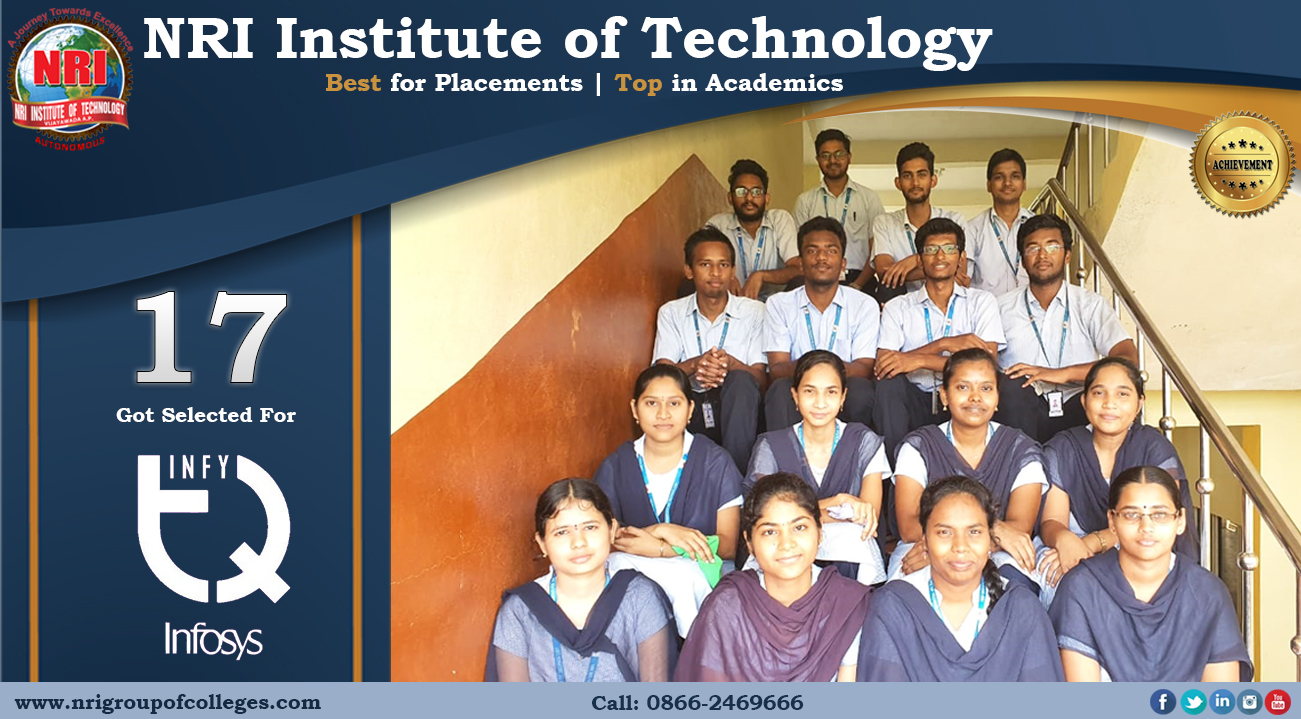
The training and placement activities by industrial experts start from the first year onwards and are embedded in the academic curriculum.